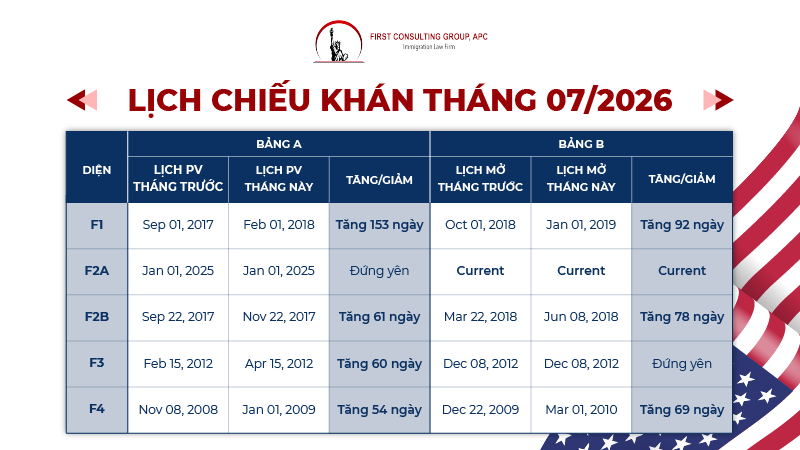
Lịch chiếu khán tháng 7 năm 2026
Jessica Dao
Tin Tức

Family-sponsored US immigration is a legal pathway that helps millions of families reunite in the United States. However, the complex process and lengthy waiting times can leave many sponsors and applicants confused, sometimes leading to incorrect petition submissions that cause years of delays. US immigration law clearly delineates each sponsorship category, who is eligible to file, and the required steps to complete—mastering this from the outset saves both time and costs. This article provides comprehensive information on family reunification visas, helping you proactively navigate each step of your immigration journey to the United States.

Family-sponsored US immigration is a legal immigrant program that allows US citizens or lawful permanent residents to sponsor their qualifying relatives for permanent residence. Under US immigration law, family reunification visas are divided into two main groups: Immediate Relative (IR) categories and Family Preference (F) categories. Applicants must prepare thoroughly to avoid errors during the visa interview at the Consulate.
Immediate Relative (IR) Categories:
Family Preference (F) Categories:
Clearly distinguishing between these two categories is the first step to filing the correct Form I-130. This prevents petitions from being denied or delayed for multiple years due to choosing the wrong category.
| Comparison Criteria | Immediate Relative (IR) Categories | Family Preference (F) Categories |
| Visa Cap | Unlimited | Subject to annual numerical caps |
| Petitioner | US citizens only | US citizens or lawful permanent residents |
| Beneficiary | Spouses, parents, and unmarried children under 21 | Unmarried children under 21, unmarried sons/daughters over 21, married sons/daughters, and siblings |
| Average Waiting Time | 12–24 months | 2–20 years |
| Priority Date | No waiting period required | Must wait according to the Visa Bulletin |
Not everyone has the legal right to sponsor relatives to the United States. US Citizenship and Immigration Services establishes clear regulations:
Eligible Petitioners:
Eligible Beneficiaries:
A frequently asked question is: “Can a 2-year conditional green card holder sponsor a relative?” The answer is yes. You only need to hold valid lawful permanent resident status, whether it is a 2-year conditional permanent resident card or a 10-year permanent resident card. However, permanent residents can only sponsor spouses and unmarried children. They cannot sponsor parents or siblings. To sponsor parents to the United States, you must become a US citizen and be at least 21 years old.
A family-sponsored US immigration case must be completed through multiple stages. Each stage requires specific documentation and forms. Our team of immigration attorneys has compiled the standard procedure as follows:
Step 1: Filing Form I-130 with USCIS
Step 2: Case Transfer to the National Visa Center (NVC)
Step 3: Submitting Form I-864 (Affidavit of Support)
Step 4: The Visa Interview at the Consulate
Step 5: Entry into the US and Receiving the Green Card
This is the standard timeline for most cases. However, individual cases may require additional documentation depending on the visa category and the applicant’s nationality.
US sponsorship cases are often delayed or issued Requests for Evidence if documents are missing. Our office advises you to pay close attention to the following points:
Many applicants make errors by submitting incomplete packages or following the wrong sequence. This leads to additional requests for evidence, extending the waiting time by another 6–12 months.

The waiting period is the most critical factor when planning to bring relatives to the United States through family sponsorship. Each category carries a different timeline:
Immediate Relative (IR) Categories (No Visa Cap Restrictions):
Family Preference (F) Categories (Subject to Visa Cap Limitations):
The priority date is the official day USCIS receives the Form I-130 petition. You must check the monthly Visa Bulletin to track when your priority date becomes current. Once current, you may proceed with the subsequent steps of the process.
Petitioner Eligibility:
Estimated Expenses:
The total average cost for a standard sponsorship file ranges from $1,200 to $1,500. This estimate excludes travel expenses or professional legal fees should you require legal representation.
To ensure a smooth approval process, you should:
Some cases may encounter visa denials due to incorrect category selection, missing documentation, or inconsistent information. Furthermore, failing a US immigrant visa interview can occur if preparation is inadequate. When a case is delayed, the sponsor must review the entire submission file to identify the root cause and implement an appropriate strategy, preventing repetitive errors.
Maintaining a valid case status and responding promptly helps shorten waiting periods. Generally, applicants have approximately 87 days to respond to a Request for Evidence (RFE). We have witnessed numerous cases closed because the petitioner failed to respond within this strict regulatory deadline.
During the administrative processing period, the sponsor must proactively track the US sponsorship case through the USCIS and NVC online systems. Certain files may trigger additional document requests or receive an RFE letter if the documentation is insufficient. Understanding your USCIS case status and meeting NVC deadlines precisely will prevent your case from being stalled unnecessarily.
Upon visa issuance, the beneficiary must plan their entry into the United States within the validity period printed on the immigrant visa. Following entry, the physical green card will be delivered to the registered US address, typically within a few weeks to a few months. Understanding your rights as a lawful permanent resident and knowing how to maintain your permanent resident status from day one helps the family avoid unnecessary legal risks.

If you require additional information or professional legal consultation regarding family-sponsored immigration files, relative petitions, or complex immigration procedures, please contact us for dedicated legal assistance, thorough guidance, and professional case management. Connect with us to receive personalized consultation and support throughout your entire immigration journey.
FOR A FREE CONSULTATION, PLEASE CALL:
– Hotline: (877) 348-7869
– Garden Grove Office: (714) 638-3111
– San Jose Office: (408) 998-5555
– Houston Office: (832) 353-3535
– Vietnam Office: (028) 3516-2118
Disclaimer: All information provided in this document is intended for general informational purposes only and does not constitute formal legal advice. Statistical data and processing timelines reflect the public records available at the time of publication. For precise legal assessments, please schedule a direct consultation with First Consulting Group.
Danh sách những bài viết hay nhất
Lịch chiếu khán tháng 7 năm 2026
Tổng hợp kinh nghiệm du lịch Mỹ tự túc chắc chắn bạn sẽ cần
Vì sao trẻ em Mỹ tự tin? Học cách dạy con như người Mỹ

Family-Sponsored US Immigration: Comprehensive Guide to Sponsoring Relatives

Phỏng vấn định cư Mỹ và kinh nghiệm giúp tăng tỷ lệ đậu
Các câu hỏi phỏng vấn diện vợ chồng thường gặp khi xin visa Mỹ
Đi định cư ở Mỹ cần chuẩn bị gì? Checklist từ First Consulting Group
ĐẶT LỊCH HẸN TƯ VẤN
Các chương trình di trú Mỹ với nhiều điều kiện và thủ tục pháp lý khác nhau. Để hiểu rõ nhu cầu của mỗi khách hàng, quý vị hãy để lại thông tin cá nhân để được hỗ trợ tham khảo chi tiết hơn. Đội ngũ chuyên viên của First Consulting Group sẽ liên lạc lại và hỗ trợ quý khách hàng trong thời gian làm việc.

USA
12966 Euclid St., Suite 520, Garden Grove, CA 92840
(714) 638-3111
USA
989 Story Rd., Suite 8075, San Jose, CA 95122
(408) 998-5555
USA
1880 S Dairy Ashford Rd Ste 539, Houston, TX 77077
(832) 353-3535
Việt Nam
Lầu 8 - Tuổi Trẻ Tower, 60A Hoàng Văn Thụ, P. Đức Nhuận, Sài Gòn
(028) 3516-2118
Việt Nam
Lầu 5 - Toà nhà Bảo Minh, 08 Phan Văn Trị, P. Ninh Kiều, TP. Cần Thơ
(0292) 383-0001
Việt Nam
Lầu 5 - Toà nhà Viettel, 11 Lý Thường Kiệt, P. Thuận Hoá, TP. Huế
(0234) 381-0016
Việt Nam
Lầu 6 - Toà nhà ACB, 218 Bạch Đằng, P. Hải Châu, TP. Đà Nẵng
0886 00 34 00