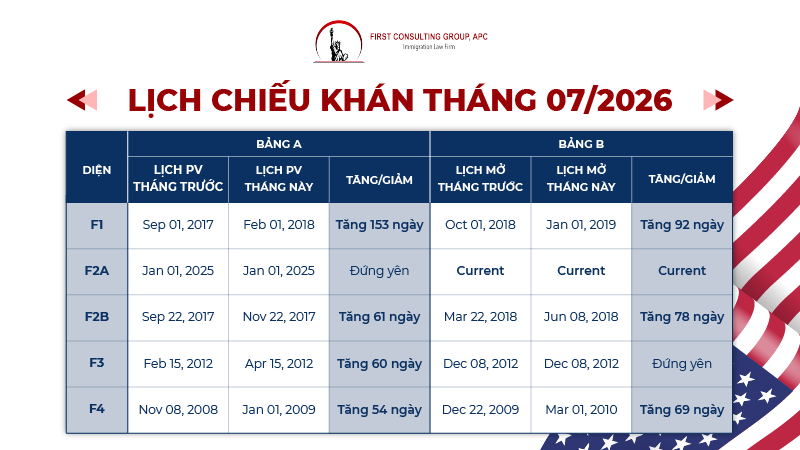
Lịch chiếu khán tháng 7 năm 2026
Jessica Dao
Tin Tức

Many people believe that after an expungement, their record becomes completely “clean.” However, U.S. immigration law does not operate under that assumption. Can a person with a criminal record that has been expunged immigrate to the United States? The adjudication depends on the specific classification of the offense, the timeline of the violation, and the strategic preparation of the documentation. Each factor directly impacts the adjudication outcome. Every case is evaluated based on specific legal foundations, rather than solely on whether the record has been expunged. First Consulting Group is an immigration firm with over 23 years of experience, a team of 100 specialists, and more than 40,000 successfully handled cases. This article will analyze this matter from a rigorous legal perspective compatible with current 2026 regulations.
Many applicants wonder whether they should disclose a prior criminal conviction when applying for a visa, or mistakenly believe they can bypass the system by omitting it. In reality, concealing a criminal record is highly likely to be detected during routine background checks, leading to severe legal consequences. If an applicant has previously been refused a visa due to a criminal record, rebuilding the application requires meticulous care and a well-defined strategic approach.
Therefore, full and truthful disclosure provides a distinct advantage during the visa adjudication process and increases the probability of visa approval, even for individuals with a prior criminal record that has been expunged under local law.

The definitive answer is no. This is a fundamental legal distinction that many applicants overlook.
An expungement (the deletion or sealing of a criminal record under domestic law) holds legal validity only within the jurisdiction of that specific sovereign state. When an application for a U.S. visa or an immigrant petition is submitted, U.S. Citizenship and Immigration Services (USCIS) and the U.S. Consulate conduct independent, comprehensive background checks. Prior judicial and criminal data can still appear within federal border control and security screening systems.
U.S. immigration law evaluates criminal history based on two primary criteria:
Regardless of whether a record is active or has been formally expunged, applicants are legally required to disclose the history truthfully on Form DS-160 or Form DS-260. Omitting this information constitutes a material misrepresentation, which carries a penalty of a permanent lifetime bar from entering the United States.
A criminal record does not result in an automatic visa refusal across all scenarios. Whether an individual with a prior conviction can be issued a visa depends heavily on the specific statutory classification of the crime:
Not all cases are evaluated uniformly. A strict distinction must be maintained between minor offenses and serious crimes, particularly those involving moral turpitude or fraudulent intent. The latter frequently trigger statutory inadmissibility. Conversely, if the infraction was a minor, isolated incident with no pattern of recidivism, regulatory avenues for relief may exist. Understanding the precise statutory classification prevents errors during the initial filing phase.

To determine whether an applicant can overcome inadmissibility and gain entry into the United States, the following scenarios must be analyzed:
Furthermore, applications involving a criminal history are scrutinized based on four core factors established by USCIS and the Department of State during document verification:
However, statutory exceptions exist where certain criminal findings do not automatically trigger a mandatory ground of inadmissibility, including:
Regarding the broader question of whether an individual with a criminal record can travel internationally, the practical outcome depends on the specific facts of the case, the severity of the violation, and the sovereign border control regulations of the destination country. In practice, files with a criminal history are categorized as complex legal matters that require a detailed statutory assessment. Applicants are strongly advised to seek the counsel of qualified attorneys or specialized organizations like First Consulting Group to prepare a compliant waiver application, thereby mitigating risks during federal adjudication.
Mandatory Pre-Filing Checklist for Applicants with a Criminal History:
The question of whether an individual who has completed a prison sentence can relocate abroad depends entirely on the specific facts and the statutory classification of the underlying crime.

An immigration waiver is required when an applicant is determined to be statutorily inadmissible, yet possesses qualifying family relationships or compelling humanitarian grounds to warrant a favorable exercise of administrative discretion. Two primary waiver applications include:
In practice, applicants who have committed minor infractions resulting in suspended sentences or offenses that occurred decades ago routinely obtain visa approvals upon demonstrating a sustained period of good moral character and rehabilitation. Conversely, applicants with formally expunged records can face immediate visa denials and permanent bars if they fail to disclose the historical event truthfully. This emphasizes that every file must be assessed on its individual merits; generalized assumptions cannot be applied to complex immigration matters.
Scenario 1: The Applicant Reaches Adjudication via Consular Processing Abroad
Scenario 2: The Applicant Files for Adjustment of Status (AOS) Within the United States
Typically, the waiver process entails a meticulous legal review of documents, gathering extensive hardship evidence, formal submission, and waiting for agency adjudication. Processing times vary widely based on case complexity and agency backlogs. Understanding these timelines and preparing a legally complete filing from the outset minimizes the risk of prolonged processing delays or burdensome requests for additional evidence.
Cases that are generally barred from securing entry or immigration benefits include:
For offenses of this severity, statutory waivers are virtually nonexistent. It is critical to conduct an exhaustive legal diagnostic prior to submitting any application to federal agencies. However, depending on the precise statutory provisions, narrow legal exceptions may apply, requiring a deep assessment of interrelated sections of the INA.
Applications involving a prior criminal record are classified as highly sensitive. A single procedural error, an omitted disclosure, missing civil documentation, or an incorrect application of statutory law can result in years of administrative delay or a permanent lifetime bar from entering the United States. Common questions such as whether an undisclosed record will be detected, whether a visa can be re-applied for after a refusal, or the optimal time to file a waiver must be evaluated thoroughly before filing to eliminate catastrophic immigration risks.
U.S. immigration law applies a multi-layered framework when evaluating admissibility, analyzing individual conduct, judicial history, and national security mandates. In highly complex files, background factors—such as an applicant’s organizational affiliations or political memberships—are subjected to rigorous vetting during the consular or USCIS interview process to ensure full compliance with federal security screening protocols.
Currently, First Consulting Group stands as one of the specialized firms providing advanced legal support for waiver applications and highly sensitive immigration profiles involving prior convictions, prior visa refusals, or formal bars to entry. Our team of experienced legal professionals guides clients through every phase of the evaluation, ensuring accurate statutory positioning and minimizing errors that could permanently impair an applicant’s ability to enter the United States.
FOR A FREE CONSULTATION, PLEASE CALL:
– Hotline: (877) 348-7869
– Garden Grove Office: (714) 638-3111
– San Jose Office: (408) 998-5555
– Houston Office: (832) 353-3535
– Vietnam Office: (028) 3516-2118
Disclaimer: All information provided in this document is intended for general informational purposes only and does not constitute formal legal advice. Statistical data and processing timelines reflect the public records available at the time of publication. For precise legal assessments, please schedule a direct consultation with First Consulting Group.
Danh sách những bài viết hay nhất
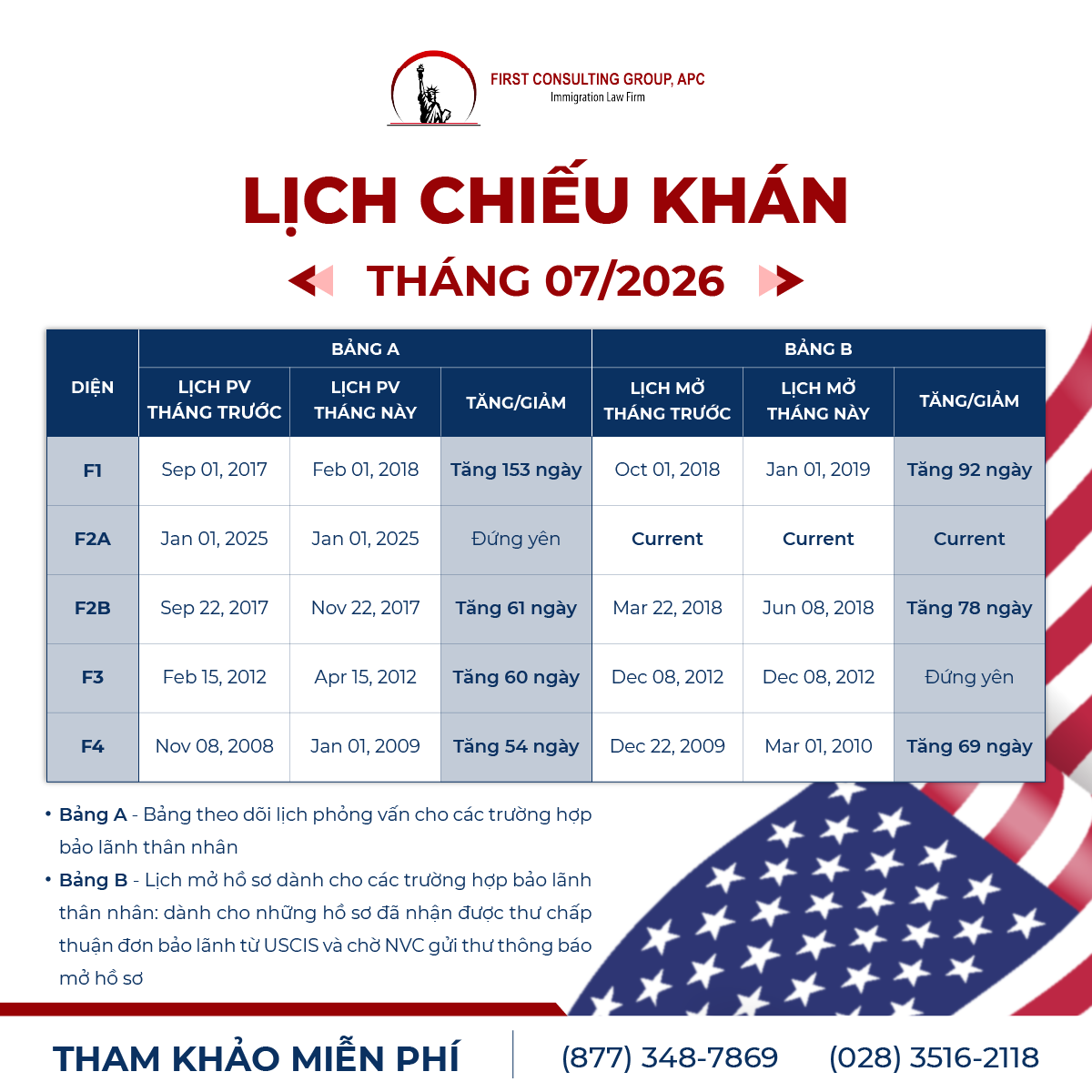
Lịch chiếu khán tháng 7 năm 2026

Tổng hợp kinh nghiệm du lịch Mỹ tự túc chắc chắn bạn sẽ cần

Vì sao trẻ em Mỹ tự tin? Học cách dạy con như người Mỹ
Can a Person with a Criminal Record That Has Been Expunged Immigrate to the United States? Insights from U.S. Immigration Law

Family-Sponsored US Immigration: Comprehensive Guide to Sponsoring Relatives

Phỏng vấn định cư Mỹ và kinh nghiệm giúp tăng tỷ lệ đậu

Nhà Trắng là gì? Hé lộ quyền lực đứng sau hệ thống chính trị Hoa Kỳ – First Consulting Group
ĐẶT LỊCH HẸN TƯ VẤN
Các chương trình di trú Mỹ với nhiều điều kiện và thủ tục pháp lý khác nhau. Để hiểu rõ nhu cầu của mỗi khách hàng, quý vị hãy để lại thông tin cá nhân để được hỗ trợ tham khảo chi tiết hơn. Đội ngũ chuyên viên của First Consulting Group sẽ liên lạc lại và hỗ trợ quý khách hàng trong thời gian làm việc.

USA
12966 Euclid St., Suite 520, Garden Grove, CA 92840
(714) 638-3111
USA
989 Story Rd., Suite 8075, San Jose, CA 95122
(408) 998-5555
USA
1880 S Dairy Ashford Rd Ste 539, Houston, TX 77077
(832) 353-3535
Việt Nam
Lầu 8 - Tuổi Trẻ Tower, 60A Hoàng Văn Thụ, P. Đức Nhuận, Sài Gòn
(028) 3516-2118
Việt Nam
Lầu 5 - Toà nhà Bảo Minh, 08 Phan Văn Trị, P. Ninh Kiều, TP. Cần Thơ
(0292) 383-0001
Việt Nam
Lầu 5 - Toà nhà Viettel, 11 Lý Thường Kiệt, P. Thuận Hoá, TP. Huế
(0234) 381-0016
Việt Nam
Lầu 6 - Toà nhà ACB, 218 Bạch Đằng, P. Hải Châu, TP. Đà Nẵng
0886 00 34 00